


Role of Surgi-ORC® in Gynaecological Surgery
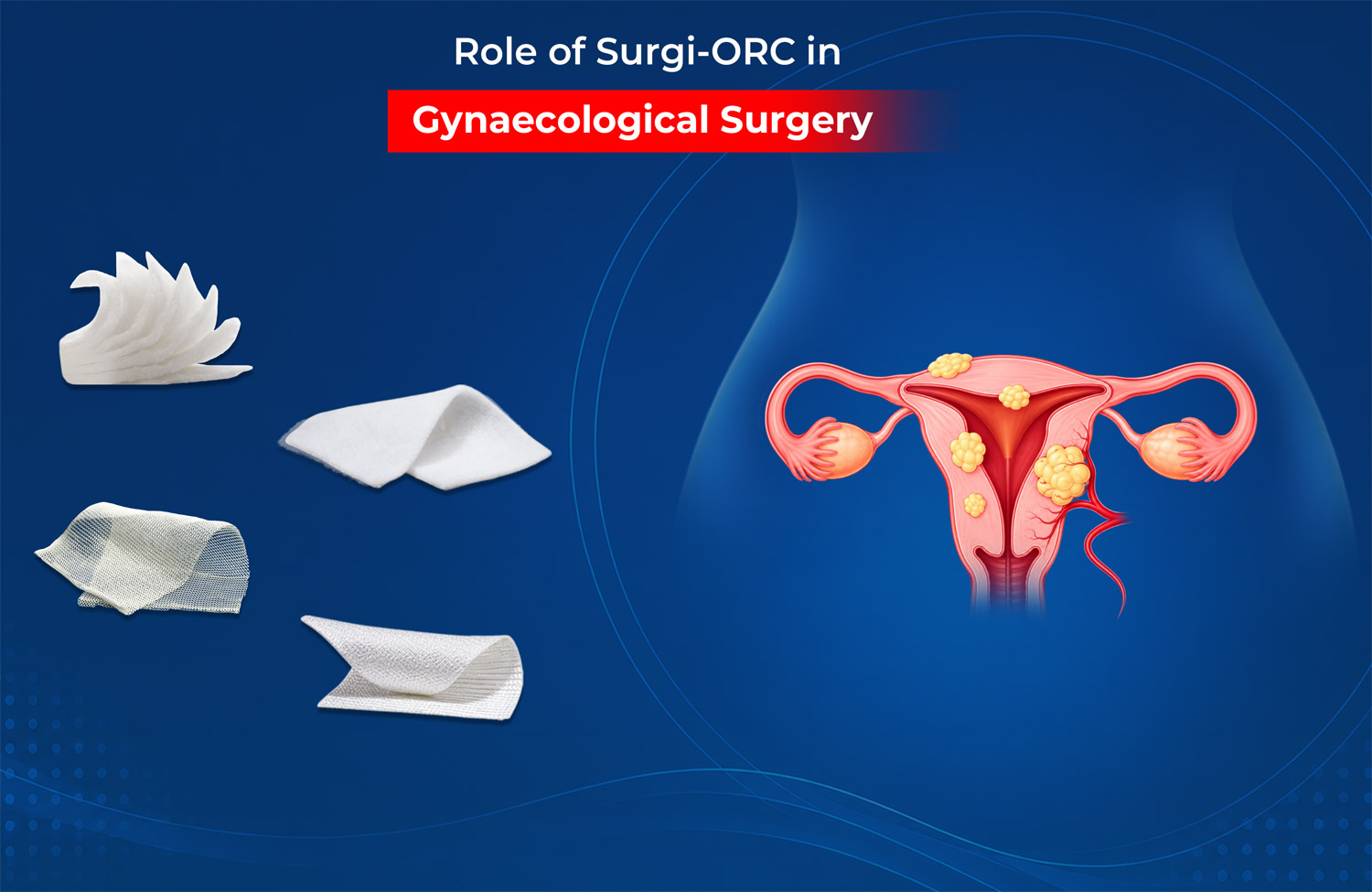
Gynaecological procedures such as hysterectomy, myomectomy, and ovarian cystectomy may involve extensive tissue operation and bleeding from highly vascularized tissues. Depending on the procedure and the patient’s clinical condition, significant blood loss may increase the need for transfusion, prolonged hospital stays postoperative infection and consequently leads to increased treatment cost.1-3 Thus, effective intraoperative haemostasis is the crucial part across diverse gynaecological surgeries.
Conventional techniques, including electrocautery, suturing, and mechanical compression remain crucial strategies for surgical bleeding control. However, persistent diffuse or oozing from delicate or highly vascularized tissues can sometimes be challenging to manage using these methods alone.3,4 In such situations, topical haemostatic agents can serve as useful adjuncts and alternative to conventional techniques. Oxidized regenerated cellulose (ORC), including Surgi-ORC® is an absorbable topical haemostatic agent that helps control surgical bleeding during gynaecological procedures.
This blog discusses the key features of Surgi-ORC® and its potential role in managing surgical bleeding across different gynaecological procedures.
Understanding the Surgi-ORC®
Surgi-ORC® is a plant-based, absorbable haemostat composed of ORC. It can be applied in dry form directly to the bleeding surface to control capillary, venous, and arteriolar bleeding during surgical procedures. Surgi-ORC® is available in multiple variants, including Original, Knit, Fibril, SNOW and Powder, to accommodate different surgical needs.
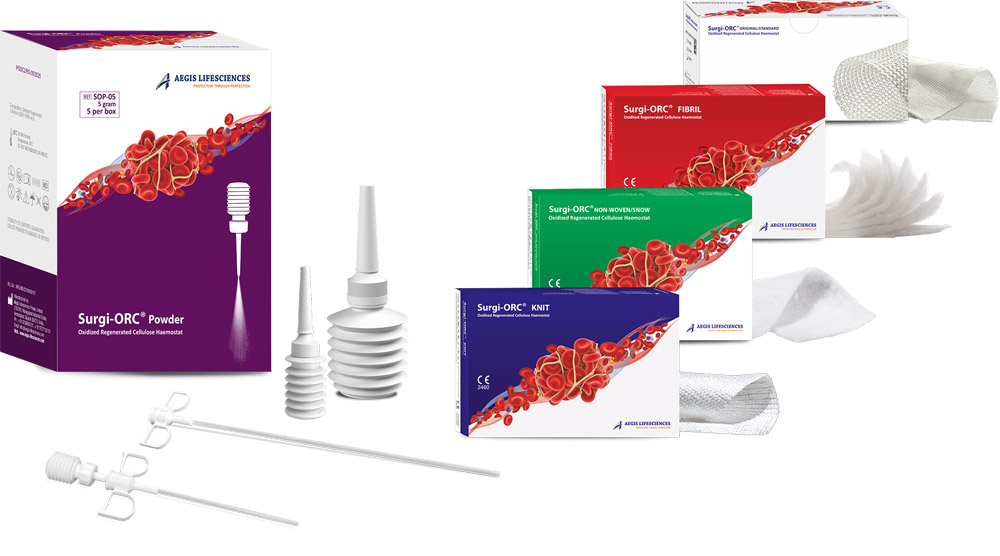
Figure 1. Surgi-ORC®: Absorbable oxidized regenerated cellulose haemostat
Key Features of Surgi-ORC® in Gynaecological Procedures
Surgi-ORC® offers several features that may support its use as a haemostatic agent for gynaecological surgery, particularly as an adjunct for managing localized surgical bleeding.
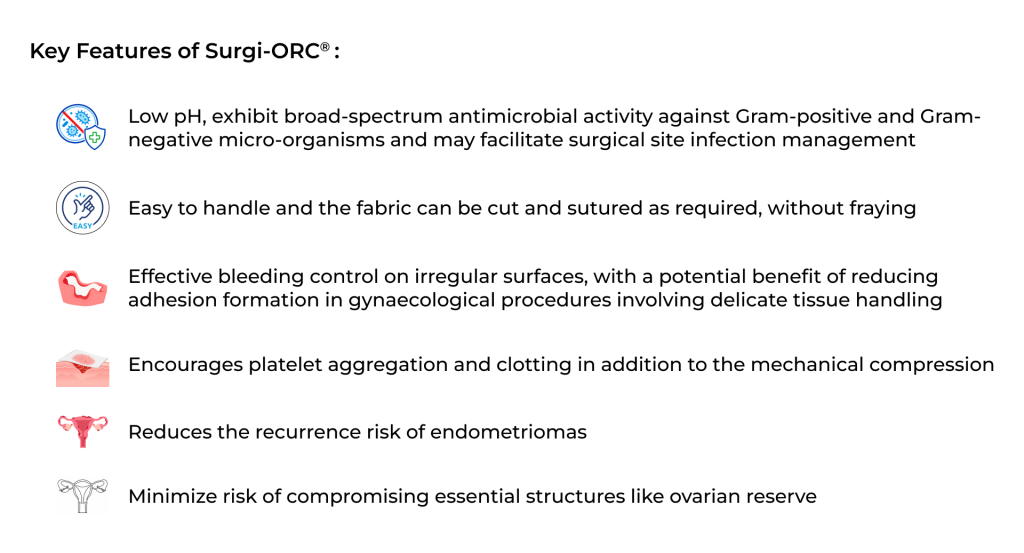
These features of the Surgi-ORC® can be useful for achieving effective haemostasis across gynaecological procedures. The suitable usage of Surgi-ORC® should be determined by the nature of the bleeding, operative site, and indications as per IFU.
Clinical Evidence: Surgi-ORC® in Gynaecological Surgery
A prospective, multicentre, single-arm observational pilot study conducted at two centres in India and evaluated Surgi-ORC® in 28 women undergoing different gynaecological procedures comprising hysterectomy, myomectomy, sacrohysteropexy, cystectomy with oophorectomy, laparotomy, and recanalization. Surgi-ORC® was applied intraoperatively to active bleeding sites identified by the operating surgeon. The study assessed time to haemostasis (TTH), short-term safety outcomes, and surgeon-reported handling characteristics. Follow-up assessments were conducted on postoperative days 2, 28, and 60.4
Key findings:
- Haemostasis: Achieved in all 28 cases.
- Mean time to haemostasis: 1.3 ± 0.43 minutes.
- Handling characteristics: Most surgeons rated the assessed handling parameters as “Good”.
- Safety: No device-related adverse events or complications were reported.
- Post-operative absorption: It is generally absorbed within 7–14 days. The absorption time may vary according to the amount applied, degree of blood saturation, and characteristics of the tissue bed.
The findings suggest that Surgi-ORC® may support effective haemostasis in selected gynaecological procedures involving mild-to-moderate bleeding. Additionally, product showed favorable handling attributes as reported by surgeons during clinical procedures.4
Read more about the clinical evidence for Surgi-ORC® in gynaecological surgery.
Applications of ORC-Based Haemostats in Gynaecological Surgery
ORC-based haemostats may provide adjunctive support for local bleeding control during different gynaecological procedures as discussed below:
- Uterine surgery: Bleeding from laparotomy or uterine incisions and uterine wall perforations.5
- Ovarian procedures: Oozing from ovarian tissue and the uterosacral ligament, including following laparoscopic endometriotic cystectomy.6
- Myomectomy: Bleeding from the surgical bed following fibroid removal.4
- Hysterectomy: Bleeding from the pelvic sidewall and vaginal cuff.4
- Postpartum care: Bleeding associated with placenta praevia, placenta accreta and the placental bed.7
Conclusion
Effective haemostasis is an important consideration in gynaecological surgery, where Surgi-ORC® may support the management of surgical bleeding. A multicentre observational study of Surgi-ORC® reported successful haemostasis in all cases, along with generally favourable handling characteristics. These preliminary findings suggest that Surgi-ORC® may be a useful adjunct for managing surgical bleeding situations in gynaecological practice. Its absorbable nature and direct application to the bleeding site offer practical benefits when used in accordance with its intended use.
Frequently Asked Questions
- Can Surgi-ORC® be moistened with saline before use in gynaecological procedures?
No, Moistening Surgi-ORC® with water or physiological saline solution before use is not recommended, as it may affect its haemostatic properties.
- Does the antibacterial property of Surgi-ORC® depend on any external agent?
No, the antibacterial activity of Surgi-ORC® is associated with the inherent properties of oxidized regenerated cellulose, including the acidic environment created by the material. This environment can inhibit the growth of certain microorganisms, including antibiotic-resistant strains.
- Can Surgi-ORC® be used to pack surgical wounds or operative sites?
Yes, temporarily, if necessary for bleeding control. However, Surgi-ORC® should not be left packed or wadded in the surgical site and must be removed once haemostasis is achieved, in accordance with the product’s instructions for use.
- Can Surgi-ORC® be used to control all types of surgical bleeding, including severe arterial bleeding?
No, Surgi-ORC® is intended to assist in controlling capillary, venous, and arteriolar bleeding and may be used as an adjunctive haemostatic agent for mild-to-moderate bleeding. It is available in different variants to accommodate varying surgical needs but is not intended to control severe arterial bleeding.
For further product-related information, visit the Surgi-ORC® frequently asked questions.
References
- Elfazari T, Nayak AL, Mallick R, Arendas K, Choudhry AJ, Chen I. Surgical indication and approach are associated with transfusion in hysterectomy for benign disease. JSLS: Journal of the Society of Laparoscopic & Robotic Surgeons. 2022 Apr;26(2):e2022-00013. https://doi.org/10.4293/jsls.2022.00013.
- Prescott LS, Aloia TA, Brown AJ, Taylor JS, Munsell MF, Sun CC, Schmeler KM, Levenback CF, Bodurka DC. Perioperative blood transfusion in gynecologic oncology surgery: analysis of the National Surgical Quality Improvement Program Database. Gynecologic oncology. 2015 Jan 1;136(1):65-70. https://doi.org/10.1016/j.ygyno.2014.11.009.
- Kilian G M Brown, Michael J Solomon, Topical haemostatic agents in surgery, BJS, Volume 111, Issue 1, January 2024, znad361, https://doi.org/10.1093/bjs/znad361
- Sharma D, Trivedi B, Karatela SN, Patel P. Evaluation of Surgi‐ORC for Hemostasis and Safety in Gynecological Surgeries: A Multicenter Prospective Observational Pilot Study. Obstetrics and Gynecology International. 2026;2026(1):5056815. https://doi.org/10.1155/ogi/5056815
- Sharma JB; Malhotra M; Pundir P. (2003). Laparoscopic oxidized cellulose (Surgicel) application for small uterine perforations., 83(3), 0–275. https://doi.org/10.1016/s0020-7292(03)00155-3
- Sharma JB, Zangmo R, Kumar S, Roy KK. Use of oxidized regenerated cellulose (Surgicel Nu-Knit) as a hemostat in laparoscopic endometriotic cystectomy: a case report. International Journal of Reproduction, Contraception, Obstetrics and Gynecology. 2015 Feb 1;4(1):283-6. doi:10.1016/S0020-7292(03)00155-3
- Portilla D, Hernández-Giraldo C, Moreno B, Quijano F, Hoyos LR, Angarita AM, Madero S. A local hemostatic agent for the management of postpartum hemorrhage due to placenta previa and placenta accreta: a cross-sectional study. Archives of gynecology and obstetrics. 2013 Sep;288(3):543-9. DOI 10.1007/s00404-013-2812-1
Important note: Please refer to the Instructions for Use (IFU) for complete information on instructions, contraindications, warnings, and precautions