


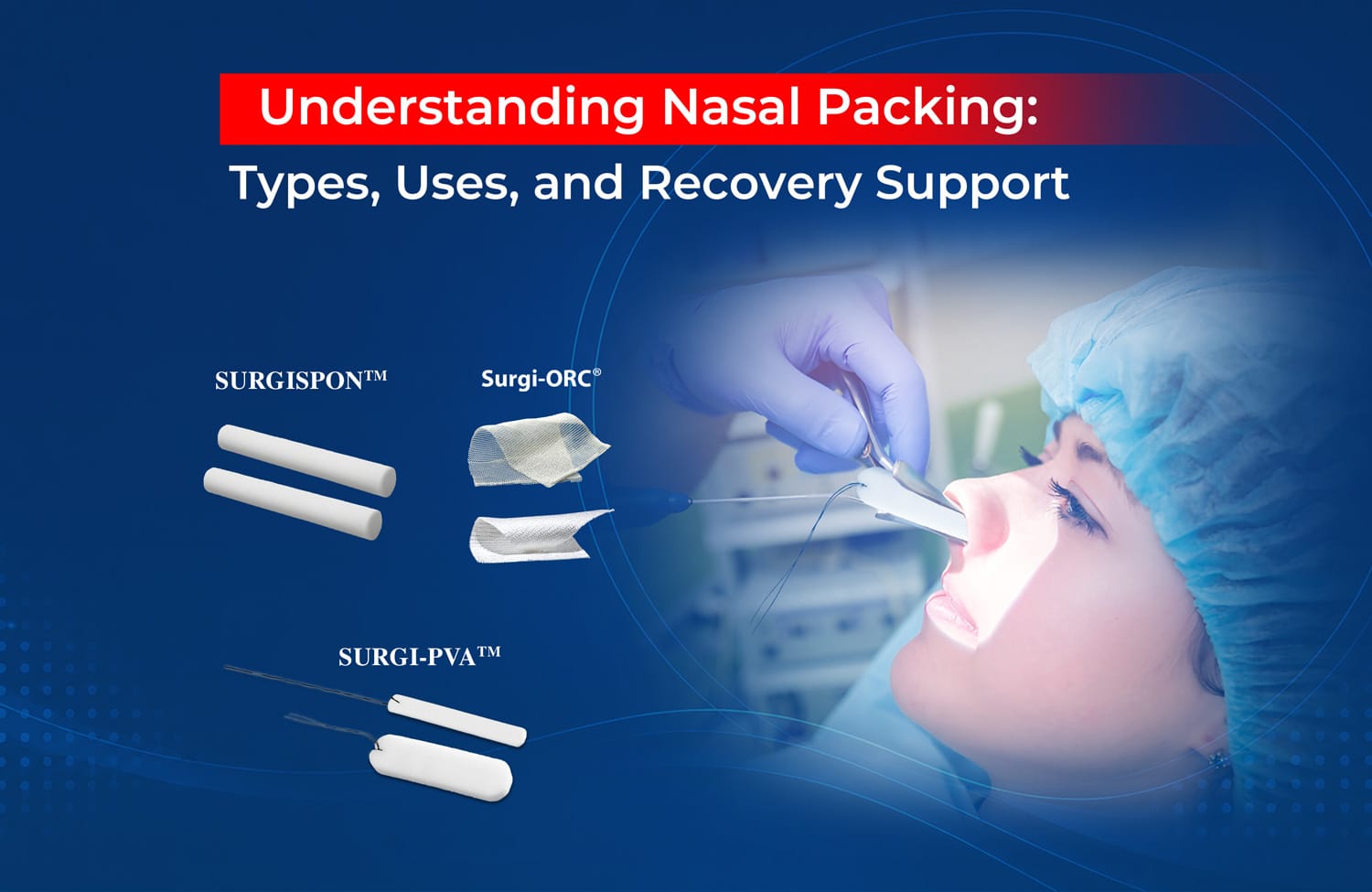
Understanding Nasal Packing: Types, Uses, and Recovery Support
Nasal packing is a fundamental component of otolaryngologic (ENT) practice, widely used for the management of epistaxis and postoperative care following procedures such as septoplasty, turbinate reduction, functional endoscopic sinus surgery (FESS), and rhinoplasty.1 By providing mechanical support, facilitating haemostasis, and protecting healing tissues, nasal packing helps reduce postoperative complications and improve patient recovery.
Today, a variety of nasal packing materials are available, including resorbable nasal packing, inflatable devices, ribbon gauze, and self-expanding polyvinyl alcohol (PVA)-based nasal pack such as SURGI-PVA™. Each type is designed to address specific clinical needs, ranging from haemostasis to improved patient comfort.
In this blog, we’ll explore different types of nasal packing for nose bleeding and how they help manage bleeding, support healing, and aid recovery after nasal procedures.
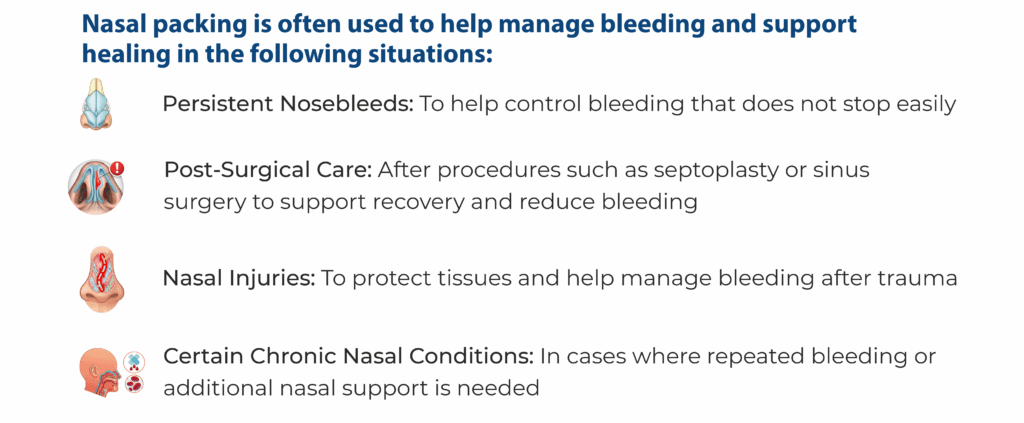
When Is Nasal Packing Commonly Used?
What Are the Different Types of Nasal Packing?
A variety of nasal packing for nose bleeding are available to control bleeding, maintain nasal cavity stability, and promote postoperative healing. Based on their absorbability and design features, these products can be broadly categorized as absorbable nasal packing or non-absorbable nasal packing:1,2
| Category | Subcategory | Common Materials | Examples |
| Absorbable Nasal Packing | Animal-Derived: Naturally resorbable nasal packing materials that support haemostasis and wound healing without requiring removal. | Gelatin | SURGISPON® Nasal Strip SURGISPON® ENT, Cutanplast®, Gelfoam®
Fig. 1: SURGISPON® nasal strip for effective nasal bleed management. |
| Plant-Derived: Cellulose-based absorbable materials that promote haemostasis, reduce postoperative pain and intranasal adhesions. | Oxidized Regenerated Cellulose (ORC), Carboxymethyl Cellulose (CMC) | Surgi-ORC®, Surgicel®, RAPID RHINO™
Fig. 2: Surgi-ORC® plant-based absorbable haemostat | |
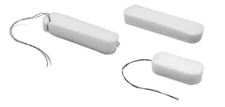
| Non-absorbable Nasal Packing | Self-Expanding Nasal Packing: The device rapidly absorbs fluid, expands within the nasal cavity, aids fluid management and drainage, and provides tamponade for effective haemostasis. | Polyvinyl alcohol (PVA)
| SURGI-PVA™, Merocel®
Fig. 3: SURGI-PVA™ nasal packs for haemostasis and postoperative nasal support |
Why Is Nasal Packing Important in Nasal Surgery?
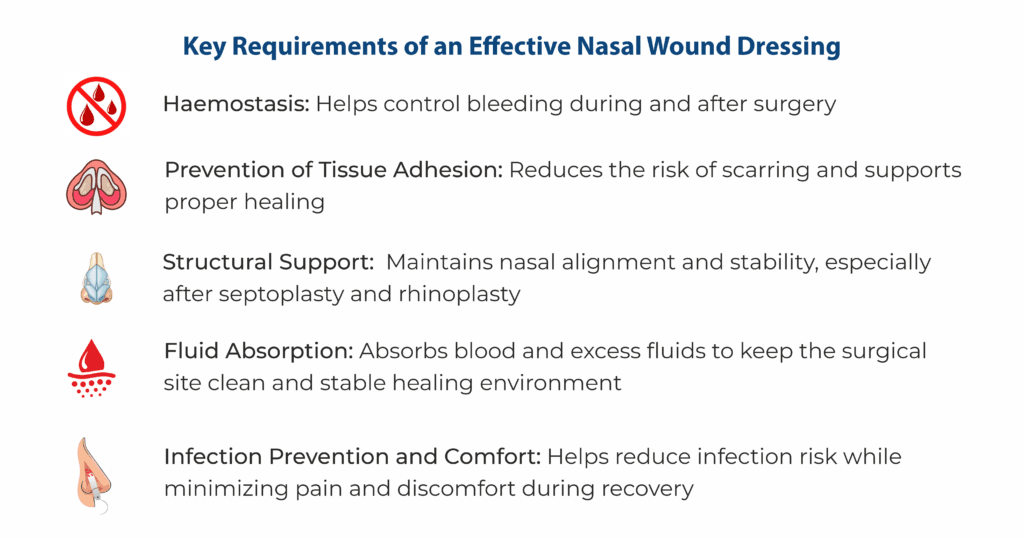
For each of these surgeries, the selection of nasal wound dressings is critical to achieving the desired outcomes. Effective nasal packing helps manage bleeding, supports the structural integrity of the nose, prevents adhesion and infection, and enhances overall comfort.1
Clinical Evidence for Nasal Packing
Clinical evidence supports the use of a wide range of nasal packing materials, from absorbable options such as Cutanplast®, MeroGel®, CMC Foam, Nasopore®, and Spongostan® to non-absorbable materials like Merocel® (PVA packs) have demonstrated clinical benefits.1-5
- External Dacrocystorhinostomy (RCT, n=41): Absorbable gelatin sponge packing reduced postoperative bleeding and improved haemostasis and anatomical success rates compared with xylocaine- and adrenaline-soaked gauze.5
- Epistaxis (n=127): PVA nasal packing is a proven first-line treatment for epistaxis, achieving successful bleeding control in 91.5% of patients. Its ease of insertion, rapid application, and reliable haemostatic performance make it a widely used option in routine clinical practice. PVA nasal packing is an effective form of first-line treatment in patients with epistaxis.6
- Functional Endoscopic Sinus Surgery (FESS) (Prospective, RCT, n=41): Levobupivacaine-soaked PVA sponge packs significantly reduced postoperative pain and improved patient comfort compared with saline-soaked PVA packs. The study found that levobupivacaine-soaked PVA packing is a simple, effective, and well-tolerated method for managing pain following FESS7
- Tonsillectomy (A cross-sectional prospective study, n=211): ORC sheet used as the primary haemostatic agent provided effective bleeding control, with no cases of post-tonsillectomy haemorrhage reported. The findings support ORC as a safe and effective option for achieving haemostasis following tonsillectomy.8
Overall, these studies demonstrate that nasal packing materials play an important role in achieving haemostasis and supporting postoperative recovery, with the selection of packing material may be guided by patient-specific consideration and surgeon preference.
Conclusion
Nasal packing helps support healing and recovery after septoplasty, inferior turbinoplasty, FESS and other nasal surgeries. Both absorbable and non-absorbable packs have their benefits depending on the patient’s needs and the type of procedure. Choosing the right nasal packing can help improve comfort, control bleeding, and support better recovery after surgery. With advances in nasal packing materials, postoperative care continues to become more comfortable and effective for patients.
FAQs
- What is nasal packing used for?
Nasal packing is used to help control nose bleeding and support healing after nasal surgeries or injuries.
- Which nasal packing is commonly used after ENT surgery?
Both absorbable and non-absorbable nasal packs are commonly used after ENT procedures depending on the surgical requirement and patient needs.
- What is SURGI-PVA™ Nasal Pack used for?
SURGI-PVA™ Nasal Pack is used to help control bleeding and support recovery after nasal procedures such as septoplasty and sinus surgery.
- Does nasal packing help prevent postoperative bleeding?
Yes, nasal packing helps apply gentle pressure inside the nose, which supports haemostasis and helps reduce postoperative bleeding.
- Can nasal packing help after septoplasty or sinus surgery?
Yes, nasal packing is commonly used after these procedures to help control bleeding and support healing.
- What are the other nasal packing products commercially available in the market?
Other commercially available nasal packing products are used for haemostasis and postoperative nasal support such as MeroGel®, Nasopore®, NasoAid, SPONGOSTAN™, CMC foam, Rhino Rocket™ and Epistat®
References:
- Which Nasal Packing is Ideal for Different Types of Nasal Surgery?
- Types of Nasal Packing Explained | Luxwisp
- Wang TC, Tai CJ, Tsou YA, Tsai LT, Li YF, Tsai MH. Absorbable and nonabsorbable packing after functional endoscopic sinus surgery: Systematic review and meta-analysis of outcomes. European Archives of Oto-Rhino-Laryngology. 2015 Aug;272:1825-31. DOI 10.1007/s00405-014-3107-2
- Cho KS, Park CH, Hong SL, Kim MJ, Kim JY, Kim YW, Koo SK, Roh HJ. Comparative analysis of Cutanplast and Spongostan nasal packing after endoscopic sinus surgery: a prospective, randomized, multicenter study. European Archives of Oto-Rhino-Laryngology. 2015 Jul;272:1699-705.
- Binub K. Evaluation of effect of absorbable gelatin sponge (gel foam) nasal packing in external dacrocystorhinostomy. Indian Journal of Clinical and Experimental Ophthalmology. 2023;9(2):221-5. https://doi.org/10.18231/j.ijceo.2023.042
- Pringle MB, Beasley P, Brightwell AP. The use of Merocel nasal packs in the treatment of epistaxis. The Journal of Laryngology & Otology. 1996 Jun;110(6):543-6. https://doi.org/10.1017/S0022215100134218
- Yılmaz S, Yıldızbaş Ş, Güçlü E, Yaman H, Yalçın Sezen G. Topical levobupivacaine efficacy in pain control after functional endoscopic sinus surgery. Otolaryngology–Head and Neck Surgery. 2013 Nov;149(5):777-81. DOI: 10.1177/0194599813502925
- Alterki, Abdulmohsen & Ali, Yaseen. (2009). 11-HEMOSTASIS WITH SURGICEL FOR TONSILLECTOMY: A PILOT STUDY. Basrah Journal of Surgery. 15. 69-71. 10.33762/bsurg.2009.55615. https://doi.org/10.33762/bsurg.2009.55615