



The Role of FLOGEL® in Pituitary Tumor Surgery

The Role of FLOGEL® in Pituitary Tumor Surgery
Pituitary tumor surgery, often performed via a minimally invasive transsphenoidal approach, allows direct gland access and faster recovery. However, the complex anatomy of the sellar region and its closeness to vital structures require high precision.1-3
Furthermore, oozing from the surgical wall cavities from the dural or nervous tissue may be troublesome and raise complications risk, making effective hemostasis crucial.4 While bipolar cautery controls bleeding but risks damaging healthy neural tissue, with deleterious neurological sequelae.4 Therefore, flowable gelatin-based hemostatic agents are useful in this setting as they enable precise bleeding control and support safer pituitary and skull base surgery.
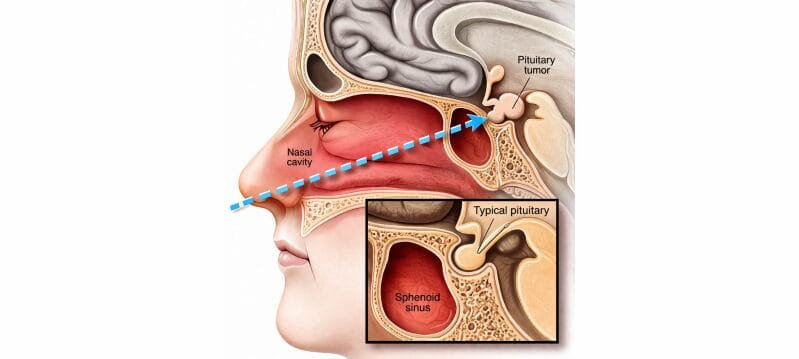 Figure 1: Endoscopic Transsphenoidal Approach for Pituitary Tumor Surgery1
Why hemostasis matters in pituitary neurosurgery
Effective bleeding control in transsphenoidal surgery is essential to ensure optimal surgical outcomes. 1,2 Inadequate hemostasis may result in:
- Bleeding obscures visualization, making surgery less safe
- Increases risk of intraoperative complications and neurovascular injury
- Poor control can lead to postoperative hematoma, a common cause of reoperation and morbidity
- Antiplatelet and anticoagulant use adds surgical challenges
- Raises the need for blood transfusion, which carries risks such as infection, coagulopathy, and fluid overload
In such scenarios, flowable hemostatic matrices like FLOGEL® provide an effective solution for rapid and controlled hemostasis. But what makes this approach particularly suitable for such complex procedures? Let’s take a closer look.
What is FLOGEL®?
FLOGEL® is a flowable gelatin hemostatic matrix made from absorbable sponge powder, prefilled in a 20 mL syringe. Supplied as a complete sterile, gamma-irradiated kit with all necessary accessories.
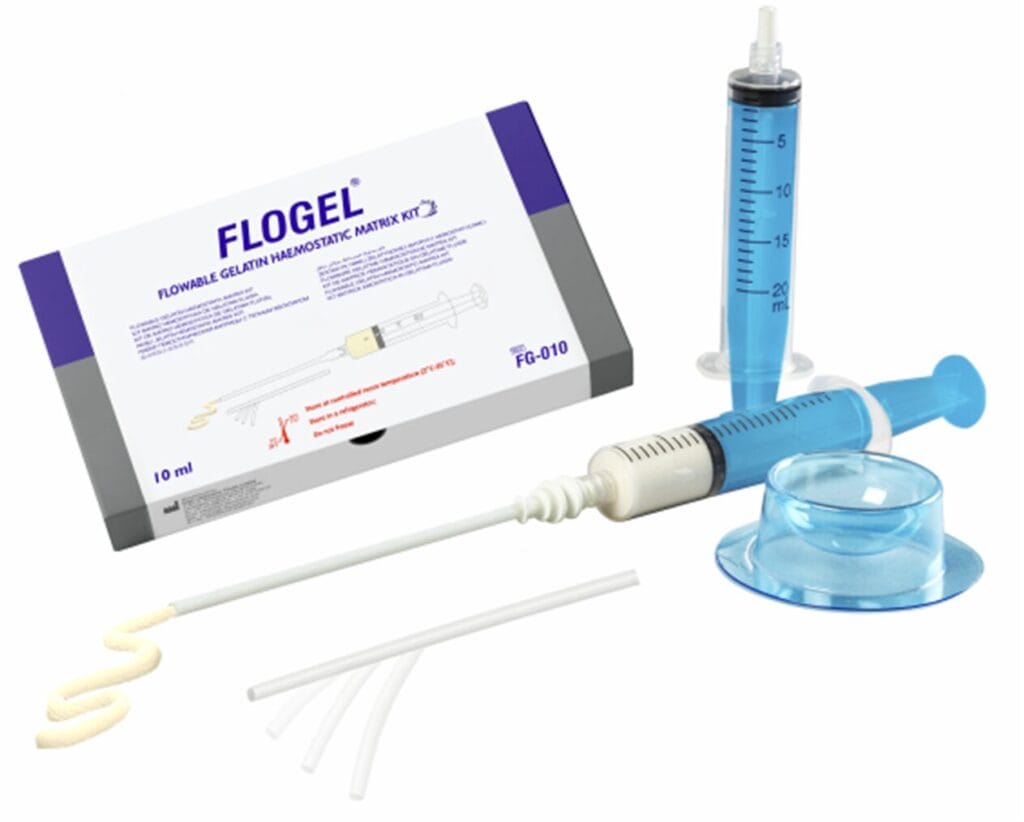
Figure 2: FLOGEL® Flowable Gelatin Haemostatic Matrix
This FLOGEL® design ensures both precise and easy to use during surgery.
Why FLOGEL®?
FLOGEL® is a flowable gelatin haemostatic matrix, works through platelet adhesion, accelerating platelet plug formation to aid in fibrin clot formation. When used in appropriate amounts, it is absorbed completely within <4 weeks. It is designed for easy application to a bleeding site in tight and irregular spaces especially at difficult to reach surgical areas.
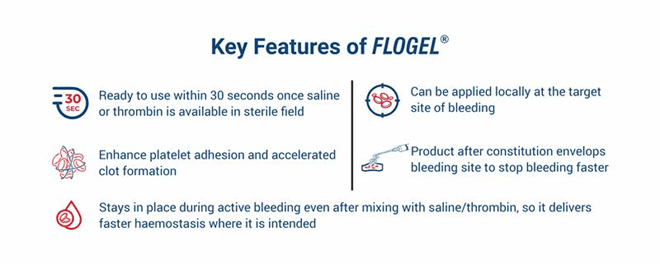 These features make FLOGEL® effective for quick bleeding control. To better understand its real-world impact, let’s explore the clinical evidence supporting its use.
Clinical experience with pituitary tumor surgery
A consecutive series of 318 patients (mean age 58.8 years) under elective and emergency cranial, craniospinal, and spinal surgeries (January 2005 and March 2012). The most common intracranial tumors treated were glioma, meningiomas, and pituitary tumors. All patients received a gelatin hemostatic matrix, achieving immediate hemostasis with no intraoperative hemorrhage in the operative cavity and no agent-related complications.4
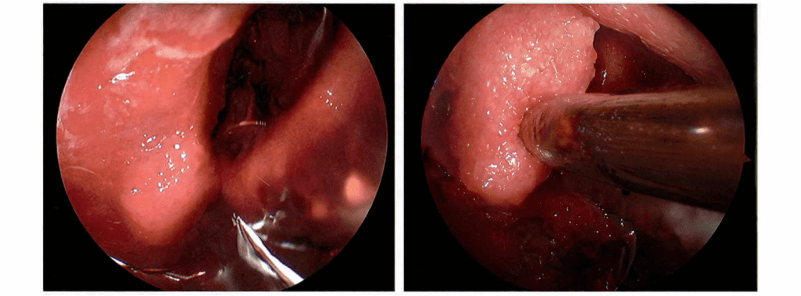 Figure 3: a. Intraoperative picture of endoscopic removal of pituitary tumor from internal carotid artery during a trans-sphenoidal approach. b. Endoscopic view of gelatine hemostatic matrix after removal of the pituitary tumor4
This study suggests these adjuncts to hemostasis are of great value for neurosurgeons in cases of difficult hemostasis.4
Conclusion
In neurosurgery, particularly around the delicate skull base, controlling bleeding during pituitary tumor surgery is essential for patient safety. Reliable hemostatic tools like FLOGEL® give surgeons a clear view, make precise surgery easier, and help improve outcomes for patients.
References:
- Transsphenoidal surgery – Mayo Clinic
- Buchfelder M, Schlaffer SM, Zhao YJ. The optimal surgical techniques for pituitary tumors. Best Practice & Research Clinical Endocrinology & Metabolism. 2019 Apr 1;33(2):101299. https://doi.org/10.1016/j.beem.2019.101299
- Liu X, Feng M, Dai C, Bao X, Deng K, Yao Y, Wang R. Internal carotid artery injury in the endoscopic transsphenoidal surgery for pituitary adenoma: an uncommon case and literature review. Gland Surg. 2020 Aug;9(4):1036-1041. doi: 10.21037/gs-20-354. PMID: 32953612; PMCID: PMC7475377.
- Gazzeri R, Galarza M, Alfier A. Safety biocompatibility of gelatin hemostatic matrix (Floseal and Surgiflo) in neurosurgical procedures. Surg Technol Int. 2012 Dec;22:49-54. PMID: 22915500. https://pubmed.ncbi.nlm.nih.gov/22915500/