The Role of FLOGEL® in Posterior Fossa Tumor Surgery
In neurosurgical operations, posterior fossa tumor removal is a very delicate procedure because it is operating near vital structures such as the cerebellum and brainstem within confined space.1 Posterior fossa tumours are more common in children than adults, accounting for 54–70% of paediatric brain tumours compared with 15–20% in adults and occur more frequently in males.2-3
Continuous bleeding can obscure the surgical field, making it difficult for the surgeon to identify and control the source of bleeding. This not only complicates the procedure but also increases the risk of injury to surrounding tissues and serious complications, including brainstem compression, herniation and mortality.3 Hence, prompt and effective haemostasis is essential for maintaining bleeding control and a clear surgical field.
What complications can occur in a postoperative posterior fossa patient?
Posterior fossa surgery carries a high risk of complications, primarily due to the anatomical proximity to the brainstem and lower cranial nerves. These complications include:
- Neurological / Surgical
Uncontrolled intraoperative bleeding may lead to poor visibility, neural injury, prolonged surgery, increased transfusion needs, hematoma formation, wound infection and other complications such as edema, hydrocephalus, cerebellar mutism, cranial nerve impairment, and CSF leak.2-5,7
- Airway / Respiratory
Loss of protective airway reflexes, dysphagia, failed extubation, respiratory failure, need for tracheostomy.2,5,
- Cardiopulmonary / Systemic
Postoperative sepsis/septic shock/systemic inflammatory response syndrome, pulmonary complications, hospital stay increased.2,6
Because the posterior fossa is a small and highly sensitive space, even minor perioperative bleeding can have serious consequences, potentially increasing morbidity and mortality.3,4 Therefore, effective haemostatic solutions such as FLOGEL® are essential for safer surgery and improved patient recovery. Let’s understand FLOGEL® and how it helps in the operating room.
What is FLOGEL®?
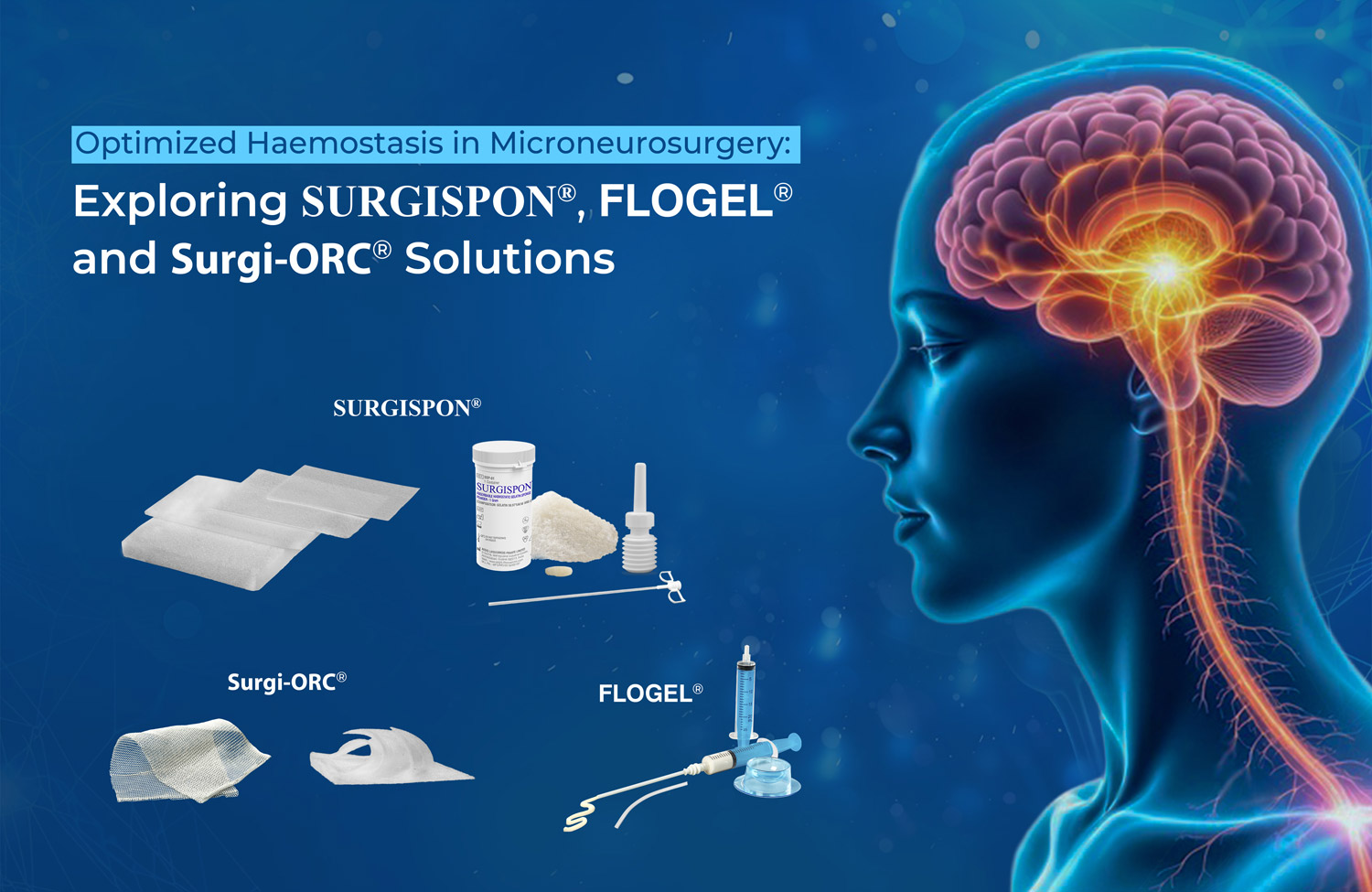
FLOGEL® is a flowable gelatin haemostatic matrix, composed of absorbable gelatin sponge (USP) powder, prefilled in a syringe. It appears off-white to slightly yellow and is supplied prefilled in a 20 mL syringe. The syringe and all preparation accessories are provided together as a sterile, gamma-irradiated kit.
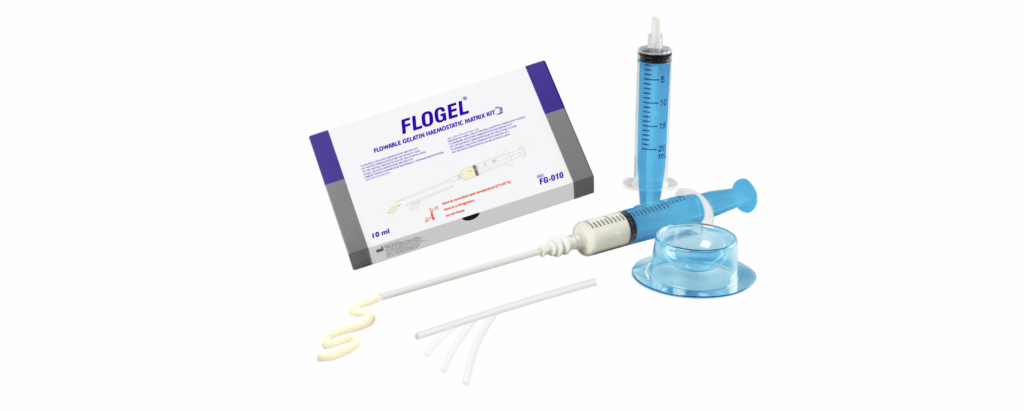 Figure 1: FLOGEL® Flowable Gelatin Haemostatic Matrix
This formulation enables precise delivery and ease of use in the surgical setting.
Why FLOGEL®?
FLOGEL® is a flowable gelatin haemostatic matrix, works through platelet adhesion, accelerating platelet plug formation to aid in fibrin clot formation. It is designed for easy application to a bleeding site that occurs in tight and irregular spaces, especially at a difficult to reach surgical site.
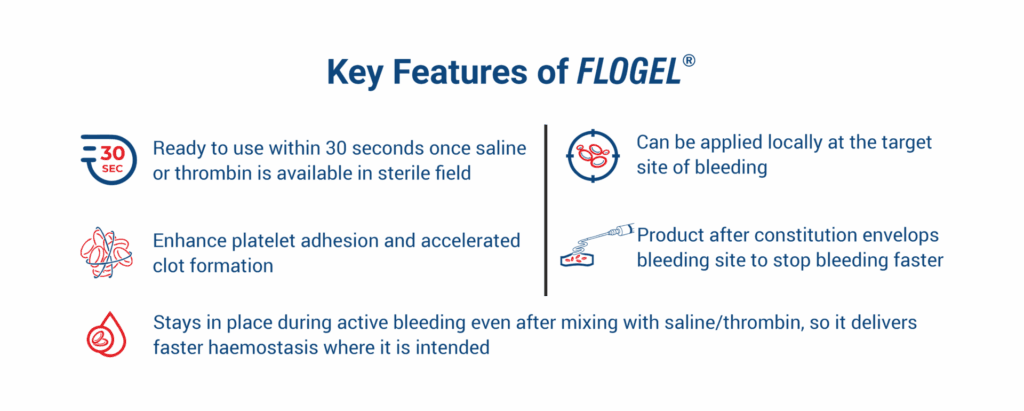 Together, these features make FLOGEL® an effective and faster bleeding control. Let’s now look at the clinical evidence supporting its effectiveness of flowable gelatin haemostatic matrix in such a procedure.
Clinical experience in pediatric patients undergoing posterior fossa surgery
Retrospectively analyzed (Between Jan-2012 and Dec-2016), 23 children (12 patients were female and 11 male) underwent posterior cerebral fossa surgery for low-grade gliomas. Standard haemostasis was achieved, followed using a thrombin-gelatin haemostatic matrix to strengthen haemostasis. Postoperative MRI and clinical follow-up revealed no matrix-related or delayed complications, supporting its safety and utility in pediatric posterior fossa surgery.5
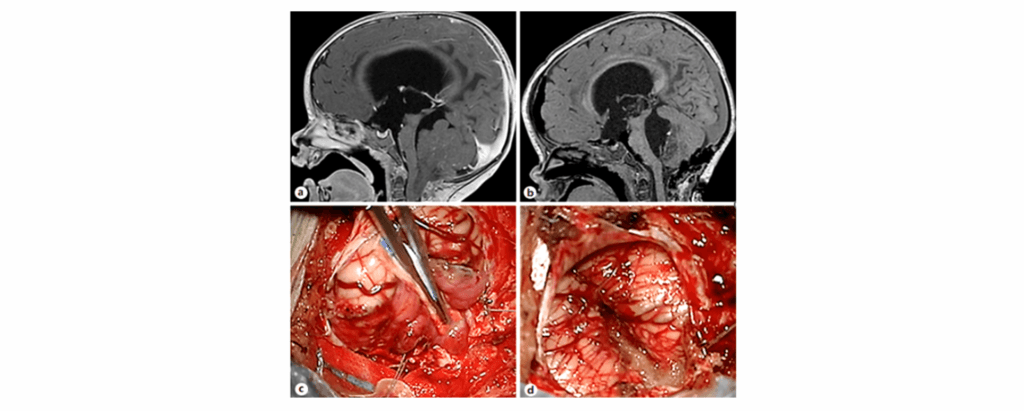 Figure 2. a) Preoperative MRI showing a lesion within the fourth ventricle b) Postoperative T1-weighted MRI confirming gross total resection without haemorrhage; histology: ependymoma (WHO grade II) c) Tumor exposure below the cerebellar haemispheres d) Surgical field filled with thrombin-gelatin haemostatic matrix5
In this study, the thrombin-gelatin haemostatic matrix sealant was found to be a valid and safe tool for strengthening haemostasis in pediatric low-grade posterior fossa surgery.5
Conclusion
In neurosurgery, especially within the confined and sensitive posterior fossa, maintaining control of bleeding is not just a technical goal- it directly impacts patient safety. Having dependable haemostatic support like FLOGEL® can help surgeons work more comfortably, promoting a clearer surgical field and supporting better recovery for patients.
Reference:
- Posterior Fossa Tumor Surgery Explained | Acibadem Health Point – ACIBADEM Hospitals – Acibadem Health Group
- Vázquez DB, Mendoza EJ. Complications of a posterior fossa post-surgical patient, review of a case. J Anesth Crit Care Open Access. 2022;14(6):179-81. DOI: 15406/jaccoa.2022.14.00534
- Emara M, Mamdouh AE, Elmaghrabi MM. Surgical outcome of posterior fossa tumours: a Benha experience. Egyptian Journal of Neurosurgery. 2020 Jul 6;35(1):18. DOI:1186/s41984-020-00083-w
- Dai K, Tokunori K, Eriko I, Kaoru Y, Hideyuki T, Ryo U, Masahiro J, Kazunari Y, Masahiro T. Efficacy of a topical gelatin-thrombin hemostatic matrix, FLOSEAL. Surgical neurology international. 2019 Jun 3;11. DOI: 25259/SNI_272_2019
- Baro V, Denaro L, d’Avella D. Securing hemostasis in pediatric low-grade posterior cerebral fossa tumors: the value of thrombin-gelatin hemostatic matrix. Pediatric Neurosurgery. 2018 Sep 14;53(5):330-6. DOI: 1159/000491824
- Scanlon MM, Culjat LW, Highland KB, Hooten KG. Perioperative complications associated with posterior fossa tumor resection: an observational study leveraging NSQIP Pediatric data. Journal of Neurosurgery: Pediatrics. 2025 Sep 26;36(6):719-28. DOI link: https://doi.org/10.3171/2025.5.PEDS24613
- Giammalva GR, Brunasso L, Costanzo R, Paolini S, Umana G, Yağmurlu K, Chaurasia B, Cicero S, Scalia G, Basile L, Gerardi RM. The role of hemostatic devices in neurosurgery. A systematic review. Journal of Clinical Neuroscience. 2021 Jul 1;89:151-7. DOI: 1016/j.jocn.2021.05.016